 BACK
Birdiya Maya Homelessness Research Project
The Birdiya Maya project is an Aboriginal community-led and owned research project which puts Aboriginal voices about homelessness at its centre. The project focused on Aboriginal people experiencing homelessness in Perth sharing, in their voice, how it feels and how things could be improved.
This project was led by Wungening Aboriginal Corporation, an Aboriginal Community Controlled Organisation (ACCO) and working in partnership with Curtin University’s National Drug Research Institute (NDRI). It provided a platform for Aboriginal people to share their stories and ideas in their own words and images, with the purpose of helping governments and services make the necessary changes to reduce homelessness for Aboriginal people in Perth. The project was guided and overseen by the project’s Community Ownership Group (COG), made up of Aboriginal Elders elected by Elders Groups across the Perth region.
To develop culturally appropriate responses to support Aboriginal people experiencing homelessness.
Wungening Aboriginal Corporation
1/1/2021
$999,534
Lotterywest
$999,534
Perth Metropolitan
Aboriginal communities
To develop culturally appropriate responses to support Aboriginal people experiencing homelessness.
- The deliberate shift in power back to the community, supported by strong and culturally grounded governance through the Community Ownership Group (COG)
- The project took the time needed to build genuine trust and relationships, rather than rushing outcomes. This was enabled by supportive funders who were willing to allow flexibility in timelines.
- Authentically amplifying participant voices, alongside embedding storytelling and cultural methods throughout the work, ensuring the approach stayed grounded in community knowledge and ways of being.
- Build Aboriginal Data Sovereignty principles into the project in an integrated way: As a result of this project and related work done in parallel to this project, Wungening have a clearer understanding of what is required to build Aboriginal Data Sovereignty principles into the project. Wungening would set up these structures from the outset, rather than building them during the project.
- Make unacknowledge power dynamics explicit: Partnering an Aboriginal Community Controlled Organisation like Wungening with a university brought a unique set of challenges, particularly around power. A key part of the work involved making these power dynamics visible and actively addressing them. This required strong and ongoing advocacy from Wungening to build trust in a community-led approach and in the role of the Community Ownership Group. It also meant encouraging researchers to move away from traditional academic ways of working and to genuinely share control. Over time, this helped shift the balance of power so that it sat more with the community.
“We all hope we could be heard. That’s the only reason to do these things. Sometimes a little voice goes a long way if it goes in the right ears.”
Participant
Opportunity
Secure and appropriate housing is a key priority under the National Agreement on Closing the Gap (Closing the Gap in Partnership, 2020). Despite this, Aboriginal people continue to experience disproportionately high rates of homelessness. In Western Australia, Aboriginal people represented 35% of the state's homeless population in 2021, up from 29% in 2016 (ABS, 2021). WA recorded the second highest rate of Aboriginal homelessness in Australia, behind the Northern Territory (ABS, 2021). These figures highlight the significant and persistent housing challenges facing Aboriginal communities and the opportunity for targeted, culturally responsive approaches that strengthen housing security and improve long-term wellbeing.
The project was conceived during the first wave of the COVID-19 pandemic in 2020, a period of significant uncertainty for both homelessness services and the people they supported. Public health restrictions forced many service providers to reduce, adapt or temporarily suspend face-to-face support, while emergency accommodation measures, such as placing people in hotels, were often viewed as temporary solutions rather than sustainable pathways out of homelessness. Implementing these measures presented a range of challenges, and in some cases led to unintended consequences, including people leaving accommodation. This environment highlighted the need for more coordinated, flexible and culturally appropriate approaches to supporting people experiencing homelessness, particularly during times of crisis.
Wungening and the National Drug Research Institute (NDRI) at Curtin University partnered to explore Aboriginal experiences of homelessness. Through conversations with Aboriginal people experiencing homelessness and Elders, it became clear that their voices were often missing from decisions about housing and homelessness services. Community members wanted the opportunity to share their experiences and help shape solutions that better met the needs of Aboriginal people. In response, Wungening and NDRI secured Lotterywest funding to undertake a community-led research project, placing Aboriginal voices, perspectives and priorities at the centre of the work.
The project aims were:
- Identify barriers for Aboriginal people in the greater Perth area in connecting with accommodation and having their needs met, especially in a crisis
- Develop an understanding of the lived experience of Aboriginal people who live with homelessness – including changes in their health, mental health, alcohol and other drug use, social support, and connecting with services
- Provide recommendations for future policy change and service delivery
Approach
This project used an Aboriginal-led, community-based participatory action research (PAR) approach.
The research was designed and guided by Aboriginal community members, particularly a Community Ownership Group (COG) of Elders, ensuring that the voices and priorities of people with lived experience of homelessness shaped the entire process. It drew on qualitative, culturally grounded methods, including yarning (a conversational storytelling approach) and Photovoice (participant-led photography and narratives), to gather rich, lived experience data. The approach emphasised ownership, empowerment, and Aboriginal data sovereignty, with participants actively involved in data collection, interpretation, and the development of recommendations. It prioritised relationships, cultural safety, and self-determination, distinguishing it from traditional researcher-led studies.
What is Community-Led Research?
Community-led research is research that is directed by the people and communities most affected by the issue being studied. The community identifies the questions, guides the process and uses the findings to inform recommendations and actions that matter to them.
What is Aboriginal Data Sovereignty?
Aboriginal Data Sovereignty recognises the right of Aboriginal peoples to control how data about their people, communities, culture and experiences is collected, used, stored, interpreted and shared. It supports self-determination by ensuring Aboriginal people have a say in decisions about their data and how it is used (adapted from Maiam nayri Wingara, 2018).
COG Membership
15 Elders elected to the Community Ownership Group (COG)
Project reach
71 Aboriginal people who were currently experiencing, or had recently experienced homelessness; >60 Elders across Perth elected Elders to represent their local communities in the project
Wungening, as an Aboriginal Community Controlled Organisation, led the project to ensure Aboriginal people had ownership of both the research process and its outcomes. The project embedded principles of community control, with participants and Elders helping shape decisions and maintain authority over their stories and data. Wungening remained accountable to the community throughout the project and, together with NDRI, ensured the research was undertaken in a way that respected Aboriginal Data Sovereignty and supported self-determination.
Early in the project, Wungening employed two Aboriginal Elders to lead community engagement and coordinate the COG. They worked alongside Wungening’s Community Engagement Lead, another Noongar Elder. This strong Aboriginal team, located in an Aboriginal organisation, brought cultural and community expertise into the daily decision making of the project.
Other major activities:
- The Community Ownership Group (COG) guided the project by setting research principles, naming the project, endorsing research methods, and advising on participant recruitment.
- Elders led engagement with 71 Aboriginal people experiencing homelessness across Perth using a range of methods, including yarning, photovoice, creative activities, filmmaking
- The COG met every six weeks to review progress and provide ongoing guidance to the research team.
- Researchers, the COG and a participant working group analysed the data, identifying key themes and insights from the yarns and other engagement activities.
- Recommendations were developed based on the experiences and insights shared by participants and COG members.
- Two public exhibitions showcased participants' Photovoice works: one at Perth Town Hall and an eight-week exhibition at the John Curtin Gallery, as well as several smaller exhibitions over the past three years.
- Four short films were produced to share participants' stories and project learnings.
- A community report was developed to communicate the project's findings and recommendations.
- Insights were translated into recommendations for policy and service reform, while engagement activities such as exhibitions and storytelling influenced decision-makers and increased empathy.
- Research participants -curated music playlist
- Two peer-reviewed published articles - https://onlinelibrary.wiley.com/doi/10.1111/gwao.13197 and the other one pending publications
“From my point of view, in my photoshoot, it was more just to be included, inclusion you know…. And I say, like, doctors preserve life, like, and they try to keep life going. And wouldn’t you want to do that with an Aboriginal culture, the most eldest culture in the whole world?... Wouldn’t you want to preserve that? I would be so proud, and I would show off my culture to the rest of the world to show the good side.”
Participant


Summary of Recommendations (see report for details)
- Put trust at the heart of housing: Government and services should commit to creating a culture of trust and understanding with Aboriginal people, and build new ways of working about housing and homelessness.
- Support Aboriginal-led initiatives to help people stay in their homes: Government and services should invest in Aboriginal-led and delivered initiatives to provide long term, flexible, practical, wraparound supports. These should be able to help people with the issues identified in this project linked to homelessness: trauma and grief, mental health challenges, family complexities and violence, drug and alcohol problems and physical health problems. These should include Aboriginal-led practical assistance on issues helping people keep their homes.
- Invest in the wellbeing of Aboriginal people who are homeless: Government and services should commit to re-designing the supports and services for Aboriginal people who are homeless. Services should be Aboriginal designed and delivered, and assist people with the factors that help them stay safe and maintain their wellbeing – connection to culture and community, positive relationships, meaningful activities, trust in others, and options which are flexible.
Impacts and outcomes
The project gained significant visibility and reach. The report was officially launched alongside an 8-week exhibition of the artifacts created by participants at John Curtin Gallery, Curtin University, with the report received by the Minister for Homelessness, Hon John Carey.
The project elevated Aboriginal voices and positioned lived experience at the centre of understanding homelessness. Through the community-led participatory approach, the project empowered participants, strengthened community ownership, and produced culturally grounded insights into the drivers of homelessness, including trauma, cultural disconnection, and systemic barriers.
Feedback from people attending the exhibition included:
Powerful and moving
- “Raw and honest depiction of homelessness”
- “…[the Home poster] really showed the differences between Aboriginal and non”
- “creative way of seeing homelessness… very moving”
- “Photovoice is very powerful”
- “thought provoking event … powerful words and images, music and stories”
- “quotes … giving greater context and power to the imagery, and … a greater insight into homelessness”
Call to action
- “We need to act”
- “… show kindness and compassion to people experiencing homelessness”
- “Consider what homelessness means for Aboriginal people – and how we better understand that”
- “Make sure the lived experiences of homeless people are heard and responded to”
Community-level outcomes
The project delivered broader community-level outcomes, particularly by building trust and supporting participant empowerment. Members of the COG reported feeling a strong sense of empowerment, with increased confidence to ask questions about how data is owned and used. The project also helped raise the visibility and value of Aboriginal-led knowledge and lived experience, ensuring these perspectives were more clearly recognised and respected.
Organisational impact at Wungening
The project had a strong organisational impact at Wungening, establishing a validated model for ethical, community-led research grounded in self-determination and cultural safety. This approach has been embedded into broader organisational practice, helping to shape how knowledge, data and decision-making are understood and shared across the organisation. The success of the COG directly led to the establishment of an Elders in Residence group, as well as the launch of a new 18-month “Reimagining Refuge” project based on the same model. In addition, the project generated important insights and supported advocacy engagement with the Department of Communities, the Office of Homelessness, and other ministerial stakeholders, helping to influence thinking and practice beyond the organisation.
Policy and sector influence
The project had influence at a policy and sector level through engagement with government stakeholders and policymakers. This helped increase awareness of Aboriginal data sovereignty and the importance of culturally grounded approaches to homelessness. The project was presented on at tTwo major forums focused on decolonising data and research delivered by Wungening, attracting around 400 participants. Attendees included government staff, Aboriginal Community Controlled Organisations, researchers, consultants, health professionals and Elders. The forum also led to the establishment of an alliance focused on Aboriginal Data Sovereignty, further extending its contribution across the sector.
Measuring impact for community-led, relational work remains complex
One of the key challenges in this project is the difficulty of capturing long-term changes in homelessness outcomes, which often take time to emerge and are not easily measured within funding reporting periods. There is also an ongoing tension between fixed funding timelines and the need to support genuine, ongoing community ownership of the work. This raises important questions about sustainability, including who continues to carry the work forward once research funding ends and how momentum can be maintained over time.
Award recipient
The project was recognised nationally by being awarded the Lowitja Institute’s Tarrn-doon-nonin 2023 Award. Tarrn-doon-nonin is the Woiwurrung term for ‘trust’. This award recognises a research project in Aboriginal and Torres Strait Islander health and wellbeing, led by an Aboriginal community controlled organisation, that was conducted to an exemplary standard in line with Aboriginal and Torres Strait Islander ethical principles and practices.
Photovoice exhibition examples
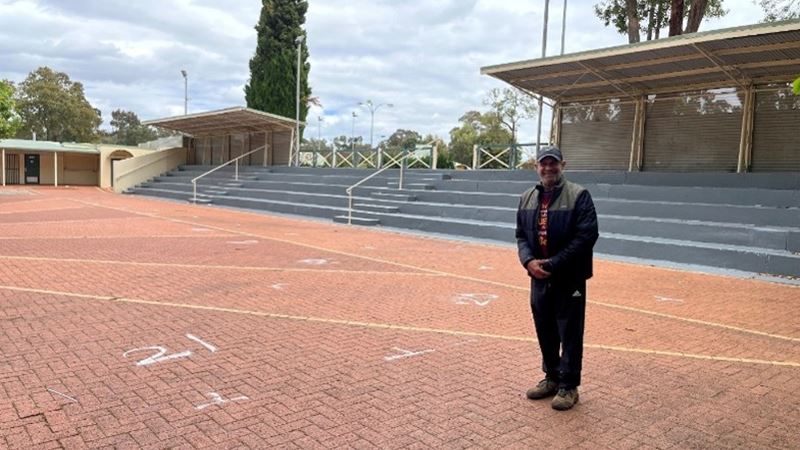
Once a Little Fish in the Pond
Andrew John Abrahamson, Participant 69, Male
I see a man who is now grown but used to play in this pool – it used to be a public pool and my parents would take me here. I found sanctuary here because I’m homeless. I feel safe here. The council leaves the ablutions open, and we comply with their rules.
Image credit: Andrew John Abrahamson, Participant 69, Birdiya Maya Project

Participant 49, Birdiya Maya Project
It’s a very annoying sign to see for the last four years. I’ve been looking at it for the last few years and thinking I could do with a bed too.
Image credit: Participant 49, Birdiya Maya Project
Data Sovereignty and Ownership
A central legacy of the project is its approach to Aboriginal data governance:
All data (interviews, artwork, insights) is 100% Aboriginal-owned and held and managed by Wungening -a community controlled organisation
The COG holds decision-making authority over whether and how data is used in future
The project contributed to broader work on decolonising data and evaluation
The project has influenced related initiatives: Murdoch University health research project (data protection considerations) and further funded work on decolonising data (completed/acquitted January 2026)
“If you want to be a part of it you could. But you had a choice. It’s not them going by and taking photos of you and that, where you’re sitting or if you’re drinking or something, you know? … Yeah, without your consent, cos a lot of people do that…. You [addressing one of the Elders on the research team] said, we have a yarn first and then they asked you if you want to sign the paper to be involved. Then they come down to the park and took a photo. And I felt good about it.”
Participant
Success factors
Several key factors contributed to the success of the project. Central to this was a deliberate shift in power back to the community, supported by strong and culturally grounded governance through the Community Ownership Group (COG). The project also prioritised taking the time needed to build genuine trust and relationships, rather than rushing outcomes. This was enabled by supportive funders who were willing to allow flexibility in timelines. A strong emphasis was placed on authentically amplifying participant voices, alongside embedding storytelling and cultural methods throughout the work, ensuring the approach stayed grounded in community knowledge and ways of being.
What could be done differently
Change 1: Build Aboriginal Data Sovereignty principles into the project in an integrated way
As a result of this project and related work done in parallel to this project, Wungening have a clearer understanding of what is required to build Aboriginal Data Sovereignty principles into the project. Wungening would set up these structures from the outset, rather than building them during the project.
Change 2: Make unacknowledged power dynamics explicit
Partnering an Aboriginal Community Controlled Organisation like Wungening with a university brought a unique set of challenges, particularly around power. A key part of the work involved making these power dynamics visible and actively addressing them. This required strong and ongoing advocacy from Wungening to build trust in a community-led approach and in the role of the Community Ownership Group. It also meant encouraging researchers to move away from traditional academic ways of working and to genuinely share control. Over time, this helped shift the balance of power so that it sat more with the community.
Next steps
Wungening will continue using the Birdiya Maya findings to advocate with government and funders for stronger Aboriginal-led responses to homelessness. The knowledge gained through the project will help shape our housing programs and future research partnerships, strengthening Aboriginal governance and Aboriginal Data Sovereignty. We will continue working alongside Elders, communities and people with lived experience to support solutions that reflect community priorities and strengths.
“So, it’s important that we’re able to have our say and people have respect one another, what they say regardless, if they agree or not. You know listen to other people’s opinions. ”
COG Member
Birdiya Maya Homelessness Research Project
For more information about this project, take a look at these resources.

Learn about wellbeing
Understand how your community is going to help you to better target and plan your project.

Ready to plan your project?
Understand your vision, plan your impact and report on the outcomes of your project with three easy interactive tools in the Community Impact Planner.
Acknowledgement of Country
Lotterywest and The Western Australian Community Impact Hub proudly acknowledges Traditional Custodians of Country throughout Western Australia and recognises their continuing and cultural connection to the land and waters, families, and community. We pay our respects to all members of the Aboriginal communities and their cultures; and to Elders past and present.